Winter is coming quickly. A lot of people see this time of year as bleak, depressing, or just boring. Here are some tips to stay attuned to nature during these months.
❄️ Go outside. Even if it’s cold, the trees are bare, and the only colors are muted and dull. We often think that summer is the only time to enjoy the outdoors—the only time to hike, meditate outside, etc. In winter, there are no lush green trees or balmy days filled with sunshine and the smell of flowers. While summer is intoxicating, winter is a time to contemplate and reflect. Go outside. Feel the cold. Feel the mud and the dead grass and the chilly wind. Listen to how quiet it is. Understand that the dark half of the year is a time of silence, stillness, and death. It’s natural to have an aversion to these things, but take some time to sit down and just listen. Breathe. Feel the reality of silence and death around you. It’s a sobering experience, but also a very insightful one. If you have any fear of death or quiet, now is the time to go sit with those things as they appear in nature and just meditate with them.
❄️ Eat cozy foods. It’s cold outside—warm up with hearty soups, stews, homemade bread, and root veggies. Warm spices and hot drinks will keep you feeling grounded. This is a wonderful time of year to practice kitchen witchcraft—focus on coziness, family, protection, and rest.
❄️ Study magic! The Dark Half of the year is devoted to self-reflection, rest, and contemplation. Snuggle up indoors with a fluffy blanket and devote some time to studying magic and witchcraft with a hot cup of magically-brewed tea.
❄️ Think spirits are sleeping along with all the greenery? Think again! The Dark Half of the year, in many cultures and spiritual traditions, is considered extremely spiritually active. Deities like Odin, Berchta, Hekate, and spirits such as elves and ghosts are very active this time of year. You can choose to honor them if you want, or practice various spirit-working techniques. If you’re into necromancy or divination, this is a wonderful time of year for those things.
❄️ Be kind to local wildlife by installing things like bird feeders outside your home. We modern humans may have an easy time of it in winter, but animals struggle to survive during these months. Any bit of kindness will be much appreciated.
❄️ Nurture your fire energy. During winter, it’s easy to internalize the cold and take on its characteristics—sluggishness, sleepiness, a foggy-headed feeling. Some crystals that are great for winter include golden rutilated quartz (aka Venus hair), citrine, carnelian, obsidian, and garnet. All of these crystals contain a strong fire element as well as offer grounding qualities, mental clarity, and protection.
❄️ Go out and forage for magical ingredients! Melted snow is extremely purifying and can be incorporated into spells for purification and cleansing. Icicles can serve as temporary wands, especially in spells that require a strong water element. The ash from bonfires (or hearth fires) can be used to make black salt. Fallen branches can be crafted into wands. There may be nothing growing this time of year, but you can get creative and still find magical ingredients in unexpected places. Just be respectful and don’t collect from places where it’s illegal!
This is by no means a comprehensive list—these are just some ways I’ve celebrated the colder months. I hope they’re helpful in any way!
This was based in kindness, not faith. It was a fearful thing. Sometimes she woke in the middle of the night panicked at the thought she might stop one day. What a world, to place the life of even as flawed a person as a Tinkerbell in the hands of children’s ability to believe.
Coming back, Wendy expected to miss the magic, the beauty, the feel of the wind in her unpinned hair. She expected to miss Peter, and she did. But she didn’t expect to miss the exhausting task of being the Lost Boys’ young mother.
And she didn’t miss it, not exactly. Wendy missed being useful, and she missed being listened to.
But she told her brothers stories, at night, still. She watched the light grow in their eyes and felt powerful for the first time since Neverland.
Michael came home from school crying one day. A boy on the playground had said fairies were stupid and fake. The teachers thought it was exhaustion or the disappointed hopes of a child who still believed his big sister’s bedtime stories. When father laughed at him at table, John hesitated for a moment and then joined in. Wendy pled an upset stomach and fled to her room.
Michael had nightmares for a week of a shining tiny person breathing their last on a Neverland forest floor.
Shaken awake in her own room, Wendy padded down the hall and creaked open his door. She gathered her smallest brother in her arms and said, “We’ll believe enough for all of them, every one. You and me, Michael, we’ll save them all.”
In the other bed John, pretending to sleep, squeezed his eyes shut. He wanted so badly to be grown.
His father had always told them true men protected people who needed it. John sat up. “I do believe in fairies,” he said, and his siblings chorused, “I do, I do.” Michael stopped crying. John started.
Wendy often asked herself why they had come back. The question surfaced over particularly tedious chores, or when her father came home drawn after a long day and picked apart her every flaw over the blandest supper Wendy’d ever tasted. But it surfaced also when she was happy, fetching sweets from the dime store, when Michael raced through the halls, hollering, an old shirt hoisted on a broom as a conquering flag.
Once, she had known how to fly. She remembered and it ached.
They tried to settle back in, all three of them, to shake lost boys and pirates from their heads. A year after leaving Neverland, Wendy’s mother asked why Wendy never brought nice girls home to play with. It took effort not to laugh.
Wendy didn’t say, “Nice girls? Tink tried to get the Lost Boys to shoot me out of the sky, tried to blow up her own home on the off chance she might get me, too.”
She didn’t tell her, “The mermaids would have liked to drown me, too, babbling away in those dolphin sounds that Peter could understand but that just gave me shivers.”
“All I want to be is a mother,” Wendy said instead, and meant, all I want is to be of use, to have people need me as much as they did. I want someone to believe my stories as much as Peter did.
She didn’t say, “And what could those girls offer me? I fought pirates. I touched the very stars.”
“I have all the friends I need in John and Michael,” Wendy offered. At mother’s frown, she added, “I’ll try harder.”
She joined a club against her own wishes. The club girls talked about dresses and Wendy thought about swords and crocodiles.
Wendy thought, these silly young things have never heard that tick tock and shaken in their boots. They’ve never seen the stars up close.
The club girls talked longingly of their mothers’ lipstick, of debutantes and growing up, and Wendy thought, How many fairies have you killed?
The years rolled on. Wendy fell in love with boys who needed her, who fascinated her, a long line of sharp-boned muses who forgot to eat their vegetables for weeks.
These boys only knew one kind of woman. They expected mothers, all of them, women childless or not, beautiful women with strength and graces pressed into their souls. If they had ever found Wendy crying over a thimble, they would not have known what to do with this alien fragile thing.
So they did not find her so. Wendy Darling was well versed in being the thing people needed her to be. Even to the most magical place she knew, Wendy had been brought for one reason. Peter’s boys had needed a mother.
That thought sat rancid in her stomach for days, but then she remembered: Peter had lingered at her window all those nights not because he needed soup or love or tucking in. He had loved her stories.
She had taken the wild boy, the lost bird, the starcatcher, and had stolen his breath away with words of her own making. On the other side of years and years, Wendy caught her own breath.
She started carrying a thimble in her pocket. When Wendy felt powerless, like a thing and not a person, she slipped a finger against the chill shape. It was a slip of puckered metal, an odd knick knack of women’s work. But once, Wendy had named it something else, given it power.
Boys boasted around her, of jumping fences and wrestling, of stealing kisses. Wendy thought, you think you know the power of a kiss? I once defeated death with a thimble, because I gave it a name. I believed. Words are power, and the words are mine.
One day, someone did find her crying. Wendy was in the girl’s lavatory. It had been a little thing, John snapping at her over breakfast, and then some boy in the yard saying something careless. Wendy had thought, I once knew how to fly, and suddenly everything seemed too dirty and too confining to stand. She hid in the furthest stall from the door, and cried angrily about every speck of magic she had lost in her life.
There was a light knock on the door and some wispy little thing from the club Wendy’d been calling her penance peeked in.
“My grandma died last year,” the girl said. “I was crying in the next stall over.” The girl sat up on the edge of the sink and said, “Do you want to hear a story about her?”
At the next club meeting, Wendy listened. A grinning redhead always used the past tense when she spoke of her father. Another girl, wan, flinched at loud sounds. They knew the sound of the ticking clock, these young women, some of them better than she ever had. Wendy had walked away from one beautiful world and into another. They had lost one, or many; or wished they could fly away the way she had gotten to, once.
Wendy stopped crying in bathrooms, mostly. She started checking them, quietly, and offering shoulders and stories of a magical land to the people she found there.
Wendy listened. One of the club girls was obsessed with trains, the way they take you away, the way they come back on schedule, the sound of them. Wendy asked, and she listened. A young woman whose hands folded in her lap like a wayward haystack stared out the window, entranced by a world only she could see.
Wendy thought, you’ve never seen the stars up close. She thought, maybe I can show you.
She dragged them all out one night, late, when they were out in the country for a school trip. They snuck out of their lodgings and got in terrible trouble for it, but that night the moon was missing and the sky was dusted with more blazing stars than they had ever seen, except for Wendy.
None of them but one odd duck knew the boys’ parts, but they did their best to dance there beneath them, to pretend they could catch starlight on their outstretched tongues.
Wendy wondered what the mermaids would have said, if she had ever learned their tongue. She wondered what stories Tinkerbell could have told her. She wondered if Tiger Lily would have taught her how to dance.
She wondered why none of the women in Neverland had been able to speak to her. She wondered why she hadn’t tried.
Michael sprouted inches and inches, his voice dropping to an alien depth. He stopped planting broomsticks tied with old red shirts on the dining room table and declaring the room claimed for Neverland.
Michael buried himself in books instead, as though that might be a way out. He started scribbling in journals, for all John teased him about it. Wendy was sure that those messy lines were not all poetry about the chin of the girl down the street, sure some of them were the adventures Michael was having still, somewhere inside. She was sure. She hoped with every ounce of herself, hoped like it was the kind of faith that makes children fly.
John buried himself in books, too, but all his joy in it was wrapped up in how they helped him win: win grades, and commendations, pats on the shoulders from their learned teachers, their father’s nod at supper. Wendy’s father had always terrified her, his hooked rage, the way he ran from meeting to appointment, pursued by the tick of the clock on his heels.
John joined debate, cricket, an honors society or two, a young businessmen’s club for boys. Wendy told him once, in a quiet moment alone, that she could hear the tick tock at his heels, too, these days.
John squeezed her hand. “Me, too, but it’s okay Wendy. C’mon, I always wanted to be a pirate.” He squeezed her hand again. “I’ll be better than he ever was, Wendy. I’ll be good.”
In their nursery room games, years ago now, John had always played Hook. Michael had played Peter.
Wendy had always been the narrator, the storyteller, the minstrel. She thought she rather liked it that way.
Wendy grew into a young woman. She went out dancing with her friends, whispered a pretend background for every eligible young bachelor who watched them, and listened to her friends’ laughter make those stories true.
They talked about dresses over light lunches, about boys and babies, about industrialism and pollution, about Plato and Darwin, the epiphanies and practicalities of falling in love. They talked Eleanor, the wispy girl from the bathroom, through her parents’ disappointment as she pursued a life as a legal secretary. Wendy dictated stories to give Ellie something interesting to practice on.
Another friend taught Wendy how to crochet. They made piles of socks for a charity drive, meeting up in the afternoons to sit in a sunlit window and crochet and talk the light away.
Wendy ran her hands over the heaps of warm socks when they were done. She was a girl who believed in magic, and this took her breath away, how patterns and patience could lead to this, could build something so good and solid.
Wendy woke and slept, told stories, kept a thimble in her pocket, breathed.
She wondered what she was building.
No child ever grows up. They grow out. They grow down and deep, textured and heavy. They grow.
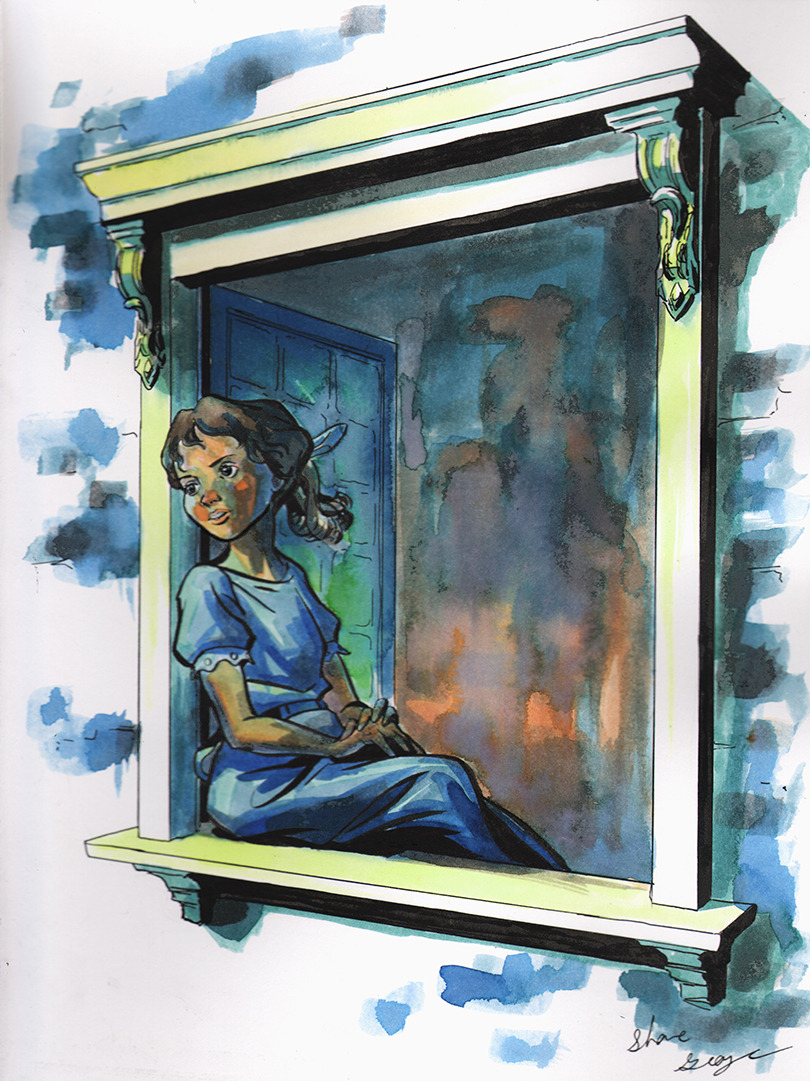
One day, decades later, Peter lighted on her old windowsill, chasing down a runaway shadow.
He thought she was her daughter. Wendy watched Jane stare up at this fey creature. Wendy could feel the weight of all the years between her daughter’s anxious gawky adolescence and her own taller years, the backaches and the tragedy, the things her hands had built. Peter would never know them. Wendy wanted to weep as hard as she once had, at fifteen, over a thimble.
Wendy went downstairs, made a bag of sandwiches that she put in a backpack with some sturdy clothes and a pair of good shoes. Her daughter would not be going on any adventures clad only in a nightgown.
When she got back, Jane was flying. Wendy’s heart was breaking, was singing, was soaring. Peter was laughing. His shadow was watching her. It knew more than it told and always had.
Wendy pulled her daughter back to earth. She gave Jane the backpack and said, “You be brave. You be good. Remember to talk to the mermaids. Ask them to sing to you. Tell them your stories.”
And what about the daughter who listened to her? who grew up with adopted aunts and six godmothers? Jane Darling got the birds and bees talk eight times, some practical, some raunchy, some petrified but determined to educate. They made period jokes, showered her with menstrual horror stories and sympathy, talked politics and philosophy, did her make-up for midnight tea parties. When Jane flew away to Neverland, she knew being a girl could mean so many things.
And yes, she had uncles too– John in his top hat, a fine business man, and little Michael who ran a grocer’s shop and wrote novels on his breaks and nights and early mornings. When she met the lost boys, she knew how to tussle with them, to elbow and spit and race to the top of the hill, to believe them when they told her they missed their mothers and not to laugh if they cried.
Jane let Peter hold her hand, but she made him translate everything Tinkerbell said. Squeaks and sparkles– she learned that a pale blue flash meant Tink wanted something, that a yellow swirl of light meant Peter wasn’t paying enough attention, that a violet flicker meant interest and just one shade darker meant affection. When Peter translated, Jane looked at Tink, not at him.
When something shiny caught Peter’s interest, she lingered in the yellow of Tink’s glow and asked careful questions. “Do you want to say something?” “Do you need something?” “It’s over there?” Two loops clockwise meant yes. A jagged zig-zag meant no. An orange flare as she dashed off meant look! watch! follow! Together, they strung a language out between them, in Jane’s words and Tink’s light.
Jane had grown up all her life on her mother’s stories. She had had a map of Neverland painted on one wall. She had called thimbles kisses and learned to fence with sticks in the back garden. But Jane had also snuck away to the library whenever she could, to read about pirates and child psychology, edible botany and adventure stories. There was more to the world than the things her mother had seen in her nightgown, eyes on Peter because back then Wendy had not yet realized all the things she was allowed to go out and meet.
On hot summer days Jane had gone up to the languages section, Dewey decimal class 400, section 497, and pulled down every book they had on Iroquoian languages. She had sounded out phonetics, learned them, whispered them. She had curled up in those ignored stacks, because her mother had brought her up to believe in so many things. One of them was magic. Another was words. One of the most important things in any world is to talk to one another.
But when Jane rushed forward to say hello to Tiger Lily in Mohawk, in Cherokee, the girl laughed at her. Jane had studied a language family from the northeast of the American continent and Tiger Lily’s people had found their way to Neverland through a tidal pathway just off Ayiti, on Hispaniola (when the tide is lowest, wade out to the second mangrove on the right and dive straight down til morning).
Tiger Lily had been a girl for as long as Peter had been a boy, round-cheeked and rounded-limbed. She had learned his English as well as she cared to. Peter had never bothered to learn their tribe’s name, and none of his foundlings had ever cared to ask after the words that danced over their heads.
But here was this girl who would try to sing with the mermaids, who had Tink flitting violet around her braids, who was standing here with old words on her tongue that were hundreds of miles from her own, looking like she was about to cry. Tiger Lily took Jane’s hand and taught her to say hello in Taino.
Between Tiger Lily’s pidgin English, Tinkerbell’s tinkling commentary, and Jane’s willingness to mispronounce anything once, they managed. When Peter irritated her, Jane would stumble scathing things to Tiger Lily in pidgin Taino and the girl would laugh like she tasted starlight.
When Jane ran out of clean underwear, she said good-bye. Peter flew her home. Tink nestled in her hair and muttered in pissed-off magenta all the way back to the world where time didn’t stand still.
But before she went, Jane had given Tiger Lily a thimble, in both senses of the word. When Jane’s feet hit her bedroom carpet, she held on tight to that warmth, the roll of another girl’s words on her tongue. There are some things you never want to grow out of.
She started counting days again, because each one brought new height, growing bones. But she did not forget. Jane sang old Taino songs in the shower and she taught her mother the words she had never thought to learn on her own adventure.
She knew her mother missed flying, the way gravity released its hold and tumbled away. What Jane missed most were nights around the campfire, the stories she didn’t know told in laguages she couldn’t quite grasp. Jane buried herelf in books for a year, looking for a way out, a way back. The world was not magic anymore. Her mother grew bent with each passing year, further and further from flight.
Every time a bit of mischief happened outside the corner of Jane’s eye–a favorite pen gone missing, a bully’s shoelaces tied together under his desk, her petty university roommate accidentally locked out on an afternoon when Jane needed a good cry, the radio suddenly switched on to something disgustingly sappy when her crush was just about to hold her hand– Jane hoped Tink had come to visit. But when she looked for a light she found none.
Visiting London to buy new clothes for her last year of secondary school, Jane got lost, separated from her parents. She squinted at the sun’s position in the sky and tracked her way down brick and concrete canyons, like she and Tiger Lily had once found their way down twisting tributaries.
She turned onto a street with wooden storefronts, piles of round bread in the windows, vegetables piled on tables. There were sharp scents in the air of spices she had never met and there were words pouring, bouncing, clattering out of doorways and off sidewalks that Jane had never heard in her life. She stumbled to a stop. She breathed in.
She met up with her parents eventually, blinked big eyes at her father and talked about how lost she’d gotten. Girls had no head for directions after all. Her mother, who had heard stories and stories about orienteering with Tiger Lily or the lost boys, hid a smile. When Jane went to sleep that night, she curled her hands over her nose. They still had tumeric and garam masala dusted in their crevices and hollows. She woke up smiling, with a faintly yellow tip to her nose.
Jane went back to the library, Dewey decimal class 400, and found she could reach shelves she’d had to get footstools for before. She also biked out, against her father’s explicit permission, to little eateries and flowershops and butcheries where the air swam with words she didn’t know. When customers were scarce, the clerks or the butcher bored, she tip-toed forward, asked questions in halting Hindi, Urdu, Greek, and listened.
When the first commerical airliner opened in 1949, Jane and her uncles saved for months and bought her mother a ticket.
There is always magic.
Jane majored in linguistics at university, tore into the marrow of dead languages and living ones. She made penpals and friends down at family-run groceries with each living one. The dead ones she held wakes for, holding her favorite phrases over candle flames and trying her best to dance her tongue through their forgotten pronunciations. They weren’t hers but, if she could, she would borrow them for awhile and lend them her lungs.
Linguistics was her life–when Jane fell in love, it was always over clever tongues and bitten lips–but she bullied her way into a chemistry class at the university for the thrill of it. It took petitions and ploys, the regal set of shoulders Tiger Lily had taught her and the lifted chin she’d used on Peter, but Jane put her notebooks down beside beakers and Bunsen burners her first day in lab class and sat down like she belonged there.
“The frequencies will be distinct to the elements that are being ionized,” said the grad student, a spectacled fellow with freckles on his waving, tangling hands. He passed out little cannisters of salts and they lit their Bunsen burners.
“What?” said the boy next to Jane, and she smiled and said, “We’re making light.”
When she lowered a dusting of copper sulfate into the flame, it burned as bright a green as Tink’s best hello.
It can be easy to feel super overwhelmed when you’re first starting off. This post is for very new witches who have limited knowledge and would like a broad overview! These are my opinions, feel free to disagree but be polite about it.
This post is a little different than the other ones, it’s all about casting spells!
Grounding and cleansing yourself:
It often is harder to focus on a spell if you are stuck in your own thoughts or have the energies from the day on you. I’ll often start with cleansing myself, by burning a sage or cedar herb bundle, and then sit and take some focused breaths and becoming present in my body.
Casting a circle:
Many witches cast circles as a way to protect themselves from outside energies or unwanted spirits while they’re performing magic. You can use the elements, a salt circle, invoking a deity, etc. Click the links to learn more! [X] [X] It is recommend you stay in the circle until you finish the spell and close the circle.
Drawing energy from something:
(So you don’t draw all the energy from yourself, which can be draining). Energy can be drawn from the elements, from crystals, deities, and many other things. This can be done by visualization and energy work or by asking.
Casting the spell:
This is when you use your ingredients and the guidelines of the spell. It is best to be completely focused so try to avoid having distractions (like your phone) and have everything you need ready to go.
Closing any loopholes:
Often, this is not included in the written spell so this is up to you. I usually write a list of loopholes I want to close before starting this process, so it’s handy when I’m finished with the spell! If it’s a spell you want to come to light in a certain way or by a certain time, this is when you clarify that. This post has more info [X]
Completing the spell and dispelling any energies:
Once you have finished with the loopholes, finishing the spell can be as simple as “this spell is now complete”. I recommend dispelling any energies you called on and returning them to where they belong. If you didn’t cast a circle, now is the time to rid of anything you may have attracted by performing your spell.
Closing the circle:
Closing a circle is fairly simple! All you have to do is the reverse of how you cast it. (If it was with smoke for example, you would then undo the circle by burning the bundle in the opposite direction).
Cleansing and grounding:
Cleansing here is optional, depends on the spell, how you’re feeling, and if you want to do it. Grounding is highly recommended. This can come in many forms. I often use water, putting drops on the key points of my face (forehead, eyelids, cheeks, nose, lips and chin) and sit while taking focused breaths.
Other considerations:
Consent: If you are casting a spell on a specific person and they do not know or they have not given you permission, you do not have their consent. Spells cast to bring a general thing (to attract love instead of to make a specific person fall in love with you), with permission, or on yourself don’t need consent/already have it!
Ingredients: Ingredients are often an important part of the spell and are included for a reason. They either represent a part of the spell, what the spell is trying to accomplish or are something you can draw energy from.
Alternative ingredients: If you can’t get your hands on a certain ingredient, you can almost always use a substitute ingredient. Just use correspondences and trust your gut while searching for the perfect substitute. General rule: Clear quartz = any crystal, Rosemary = any herb, Rose = any flower.
Belief: If you don’t believe the spell is going to work – it probably won’t. To combat this, take the time to find a spell you really believe will work and write a list of ways you might expect it to present in your life.
Intention: Similar to belief. I’ve performed magic only using a pen, paper, and my powerful intentions. The more powerfully you want something and bring it into your life, the more likely it is to appear. Intent is the end goal, why you’re casting the spell.
Deities: I do not use deities in my spellwork (or witchcraft at all). There is a huge amount of respect and connection-building that is required before asking a deity to help with your spell. I tend to avoid spells where a listed ingredient is a deity. (If you do have a connection with a deity, by all means ask them to help you out if that feels right to you!)
Energy: It is common to feel drained after casting a spell. Grounding yourself, casting a circle and drawing energy from other things all help with this, but allow yourself some time to recover. [X]
I’d like to note that a part of my post turned out very similar to @lunaesteria‘s post, which you can find here. It was not intentional but I feel it’s important to acknowledge! Some things are also phrased differently there so I’d recommend reading both.
Just to let you all know, on Sunday the 23rd of September, Mabon is happening!
Now, that’s great, but… what is Mabon?
Mabon is a pagan holiday that takes place on the annual Autumnal Equinox (which this year is on Sunday, September 23rd).
Also called Harvest Home, it is a time for celebration and for reaping what you have sewn.
It is a time to give thanks to Gaea, our Mother Earth.
Mabon is also the name of the welsh god of light and the son of the Earth Mother, Modron.
How do you celebrate Mabon?
Witches celebrate Mabon in a number of different ways. Typically, witches will incorporate the symbols of the harvest holiday into their day.
These symbols include items such as horns of plenty, ivy, and pine cones; foods such as pomegranates, pumpkins, dried seed, and apples; colours such as orange, gold, maroon, brown, and red.
Many wiccans have a large feast on this night, filled with the foods of the holiday such as potatoes, carrots, squash, pomegranates, apples, and onions. It is sometimes seasoned with the herbs of the god Mabon (rose, honeysuckle, acorns, thistle, and ferns) but make sure they’re edible!
Some witches build an altar for Mabon and decorate it with the symbols of the harvest holiday, as well as with tools (such as hand trowels, baskets or scythes), and a yellow or orange candle. When the candle is lit, many witches offer a prayer to the Goddess Mother or the Green Man.
What are other things to do on the holiday?
There are many things to do! Here are just a few suggestions.
Practice apple magic, go on a long walk in the woods, listen to music, do arts and crafts, and spend time with your family and friends!
Mabon is a time of balance. Meditation for harmony is great to do on this holiday. Maybe even meditate outside if it’s not too cold!
Celebrate the hearth and the home and cleanse your home by burning sage or using consecrated water. Decorate your home with symbols of the harvest season!
Leave an offering of thanks to the gods of the vine. Whether that is Dionysus, Bacchus, the Green Man, or other gods! Leaving an offering of wine, honey, apples, frankincense, etc.
I hope you all have a wonderful harvest season and a great Mabon! Feel free to leave a comment of how you’re celebrating this year. Blessed be to all!

 tumblr archive